Posts

The importance of nationality (the Albanian case) and the danger of utopianism according to Sir Roger Scruton by Albert Bikaj

Image
Language, territory, culture, tradition, and history are elements that unite individuals, transforming them into a community that shares common interests, rights, and obligations. This social connection, developed as a political concept throughout the history of human civilization since its genesis has been and continues to this day to remain closely connected with the desire for freedom and self-government of a people. This desire, transformed throughout history into political ideas, has been and remains the source of the ancient virtue of patriotism – a virtue developed especially in the Greco-Roman civilization, from antiquity, the Middle Ages to the present day. The majority agreed with this opinion, but after the catastrophe of the middle of the 20th century, continuing until today, the views on the nation and patriotism have changed radically. A significant number of intellectuals and influential politicians share diametrically opposed opinions regarding the concept ...

A brief reflection on the crisis of Progressivism*

Image
Ingram Pinn   Nowadays we often read and hear the word crisis ; it has become the main headline. It’s been discussing the intellectual and moral crisis; the crisis of society, the crisis of democracy, [the] Church crisis and even a rapid decline of the Western civilisation. Some of us may consider these concerns as alarmist and way too pessimistic, but having in mind the current situation, which is quite concerning, we simply cannot ignore the facts. Pretending facts don't exist, doesn’t change a single thing, it doesn’t change the truth. Yet, some seem to prefer to shut their eyes and continue living indifferently, as nothing is happening, or even quite the opposite, as optimists – as eternal progressives do – complain that we have been stuck backwards and we need to push forward to achieve progress. As the notable C. S. Lewis said, we all want progress, but obviously, the problem is that we don't agree with the direction; we, Christian conservatives, think that society is...

Aquinas and the Medieval intellectual honesty

Image
  Aquinas holds that if someone gives a bad argument for God, we shouldn't act as if everything is ok because 'at least they are on the right team.' We should shoot the argument down, Aquinas says, lest people think that belief in God is based on this bad reason . —Michael Gorman (Thomistic Institute) This is a ‘Medieval’ thought-provoking idea; it could be surprising for many of us contemporary people, but Aquinas, and Thomists in general, have always tried to be intellectually honest as much as possible. One could dare to say even more than the average contemporary thinker. My initial idea of Aquinas, and other Medieval philosophers, was a ridiculous and irrational caricature influenced by the modern thinkers, who might have never read his works at all. The notable Thomist philosopher, Edward Feser, has been arguing the same thing, for years. I learned a little about this two years ago, when I began reading Aquinas’ Prima Pars of Summa Theologica; I was simply ast...

How should we view the despair of Judas?

Image
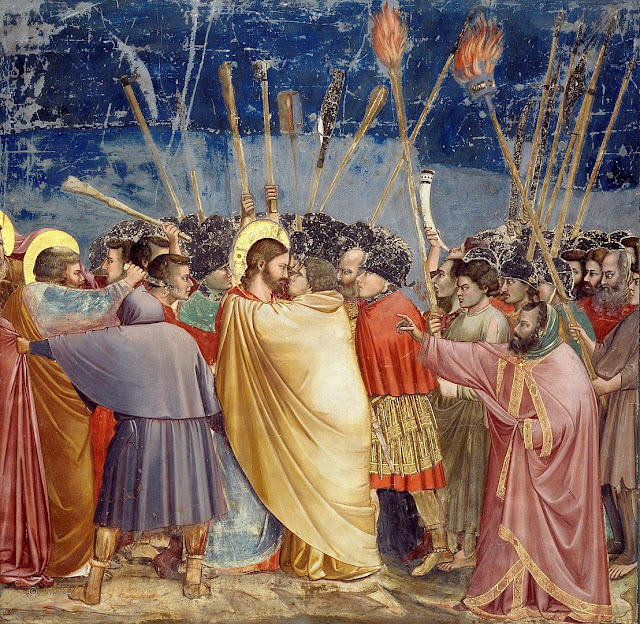
Kiss of Judas (1304–06), fresco by Giotto, Scrovegni Chapel, Padua, Italy Since we're near the end of the Holy Week, I thought to share my reflections on the Good Friday, with a special focus on Judas and the controversial topic of suicide. Recently, we have witnessed a tendency of rehabilitating Judas' suicide, and suicide in general, even by certain theologians in the past and present. Through the analysis of this topic, I see the necessity of saying a few words on the nature of sin, hope, and mercy. In our secularized era, the aforementioned concepts might sound as outdated or even meaningless. So, we should start by questioning the definition of sin. According to the Compendium of the Catholic Catechism, sin is defined as the deliberate action which separates one from God.[1] So basically, sin is a 'sui generis' apostasy, and understanding the pain of despair, our weak human nature, it is natural to show a kind of compassion. Because at a certain moment of our...

History of the miraculous portrait of Our Lady of Scutari

Image
  This medieval painting is called "Mater Boni Consilii" (en. Mother of Good Counsel; sq. Zoja e K'shillit t'mirë), also known as "Our Lady of Scutari" (sq. Zoja e Shkodrës). It's located in the Augustinian Church of Genazzano, near Rome. Many scholars believe it was painted by the Italian renaissance artist Gentile da Fabriano during the first two decades of XV century. What makes it special, is its story. According to the Medieval legend, on the feast day of St. Mark, in 1467, [during the time of the Albanian-Ottoman war], two Albanian noblemen were praying in the church, asking for protection of the Holy Mary before exiling to Italy. The image, which was located in Shkodër (it. Scutari), was, allegedly, lifted in the air by angels, who announced the fall of the city under the Ottomans, and accompanied the two men to Rome. Thus, miraculously, it was transported to Genazzano. The locals, as the tradition says, in the midst of celebration, heard ...

The myth of Flat Earth?

Image
You've probably heard that the Medieval people thought the Earth was flat. Is this true? I'll show you some images from various manuscripts, as well as quotes from two well-known Medieval scholars. Regarding this issue, here’s what Bede Venerabilis (673-735) says: “ Why the same days are unequal in length? The reason why the same (calendar) days are of unequal length is the roundness of Earth ...”  Bede, The Reckoning of Time , trans. Faith Wallis (Liverpool University Press, 1999), pp. 91.  God the Geometer 13th century . Full quote:  The Creation of the World and the Expulsion from Paradise (1445) by Giovanni di Paolo St. Thomas Aquinas O.P. (1225-1274), the most famous Medieval and Catholic thinker, knew that the Earth was round. Here's what he said: “[ T]he astronomer and the physicist both may prove the same conclusion—that the earth, for instance, is round: the astronomer by means of mathematics (i.e., abstracting from matter), but the physicist by means of matter i...

How the Enlightenment ideology obscured our historiographical imagination

Image
The Ancient of days by William Blake (1794) I’m a graduate in Medieval Studies, and when I try to explain some myths about it, people look at me as if I was insane. The Enlightenment propaganda is so strong, that telling the truth about Medieval era sounds like a crazy right-wing conspiracy theory. And this is a serious problem. Many school textbooks, media, etc. promote most of these myths, which are inherently biased and dangerous, because they distort the truth.  The Enlightenment historiography is still the most successful propaganda ever made; it refused to die, because the [anti-Christian] sentiment which these thinkers had promoted seems to be popular ever since. Demonizing the Other is the best way to begin a fight, because it gives you the feeling of the moral superiority. In our case, this has been done by distorting and misinterpreting historical facts, and inventing myths and false villains and heroes. This genius propaganda has affected and influenced most of us, there...

Gratitude for Sir Roger Scruton: in memoriam of the great philosopher

Image
Conservative writer and philosopher Roger Scruton, photographed in London in March last year © Greg Funnell (www.ft.com) Remembering Sir Roger Scruton, the profound English philosopher, writer and artist who, unlike his contemporary colleagues, was a thinker as much as a doer; and to me, a Professor and mentor whom I never had the chance to meet in real life, but only through his writings and virtual lectures. The news of his passing away last year touched and saddened me, among many other people, who valued him, his cause, and thinking. Therefore, today I'm writing a short reflection, as a sign of gratitude and to honour his memory. I began reading Sir Roger Scruton, for the first time in 2016; it was for my political ideology class at University. Back then, I have to say, my views were much different than now. More or less, liberal-left-leaning, like most Humanities' students. I was warned to be careful, and I had prejudices not only towards him, but the conservative philos...

The 30th anniversary of the first public Mass in Albania

Image
On the 4th of November, thirty years ago in 1990, Albanian Catholics and non-Catholics gathered spontaneously at the former Catholic cemetery of Rrmaj in Shkodër, Albania. They were waiting for the surviving priest to say the Holy Mass. Since the Communist government had killed and convicted most of the clergy and laity, and eventually banned religion in 1967, the aforementioned action was considered deadly. The brave priest Dom Simon Jubani (pictured here) showed up, improvised the altar, and brought a Missal, crucifix, and vestments which he had kept secretly for decades.  Rev. Simon Jubani celebrating the Holy Mass according to the Ancient Roman Rite, Versus Populum Knowing he could be killed during the Mass, Fr. Robert Ashta O.F.M. decided to wear the liturgical vestments as well, in order to be there to finish the Mass if necessary. Thank God, nobody was shot. The first public Mass was celebrated in Latin according to the traditional Roman Rite, because neither of the survivin...

The issue with neoliberalism: a traditional Conservative critique

Image
  L'Allegoria della Virtù e del Vizio by Lorenzo Lotto Recognizing the disastrous history of totalitarian regimes, R. Reagan and M. Thatcher minimized the government and promoted the free market, thinking they would give more liberty to the individual and prevent the rise of totalitarianism. But evidently, they had 'forgotten' about the existence of mega-corporations—that grew big enough to fill up the governments' place/role, in which they systematically impose certain ideologies, and of course, exploit and oppress the Middle and Working classes. Their idea of individualism, of course, had gone too far, at a point which one may think they had forgotten about the existence of common good and society—whose existence Thatcher and a few neoconservative thinkers and politicians had begun to deny. If one thinks deeply, the concept of the neoliberal Free Market is quite nihilistic and indifferent in its nature. The idea of ethics, common good, and culture doesn't seem t...